


Does your team spend hours (or even days) creating content, optimizing your website, and investing in marketing campaigns only to fall short of your quarterly goals?
You’re not alone. Lead generation is a constant challenge for businesses of all sizes and industries, but there’s a solution. A focused lead generation strategy attracts high-quality leads, converts them into customers, and ultimately grows your business.
Here are 20 tried-and-proven lead generation tips and best practices that can up your game this year.
1. Define your ideal customer profile (ICP)
An ideal customer profile (ICP) is an informative blueprint that outlines the specific characteristics and needs of the customers who stand to benefit the most from your product or service.
ICPs cover aspects like demographics, and psychographics that offer a 360-degree view of your ideal customer’s persona. Insights into your target customer’s age, location, values, and desires help you create tailored strategies that resonate deeply with your audience.
The result? Reduced marketing waste, satisfied customers, and greater return on investment (ROI).
Here are some templates from HubSpot to get started.

Targeted lead generation strategies that keep an ideal customer in mind are like precision tools that allow you to reach the right audience and speak directly to their unique worldview.
2. Use market research to know your audience inside and out
Market research involves gathering, analyzing, and interpreting data and insights about your target audience, competitors, and industry trends to guide your lead generation strategy.
Think surveys, focus groups, in-depth interviews, social media listening, and competitive analysis. These are just a few market research methods that provide nuggets into consumer behavior and preferences.
Comprehensive market research pinpoints your target audience, the marketing channels they use, and what they’re interested in.
Some tips on conducting market research:
- Define clear objectives. Set specific research objectives. Determine what you want to learn about your audience, competitors, and industry trends to get focused and actionable results.
- Use multiple methods. Combine multiple methods to get a more holistic view of your audience.
- Segment your audience. Divide your target audience into segments based on demographics, psychographics, or other relevant criteria.
- Engage your audience. Encourage customer feedback and reviews. Engaging with your audience through surveys or feedback shows you value their opinions.
- Evaluate competitors. Study your competitors to understand their strengths and weaknesses. Identify gaps in the market that your product or service fills, and use this knowledge to differentiate yourself.
3. Solve problems and attract leads with valuable blog content
Create blog content that answers your target audience’s questions and builds trust and authority. This content positions your brand as a reliable source of valuable information, driving leads to your website.
Blogging is powerful — most respondents in a survey reported that it drives results like website traffic, brand awareness, and, of course, lead generation.

Not sure where to start? Create valuable blog content with these tips:
- Use research to back it up. Support your content with data and research from credible sources. You gain authority and credibility this way.
- Make it product-led, but not sales-y. Address your audience’s pain points and questions while subtly showcasing how your product or service can fit into a solution. The focus should be on providing the solutions, not a hard sell of your offer.
- Keep the call to action (CTA) subtle. Guide readers to take action in a friendly and non-intrusive way. Use CTAs that spark engagement, like inviting them to read more content on your blog.
- Use stories and examples. Incorporate real-life stories and examples that illustrate the points you’re making. Your content will be more relatable and easier to understand.
- Solve specific problems. Focus on solving one or two specific problems in each blog post rather than trying to cover too much ground. Reading becomes more enjoyable and in-depth as a result.
Content marketing is one of the most proven lead generation best practices. It consistently delivers strong results and can be used in a variety of ways. If this isn’t yet a priority, consider making it one in the near future.
4. Use lead magnets and gated content to capture leads
Have you ever seen one of those pop-up offers promising you a valuable resource like an eBook, report, webinar, or template in exchange for your email address? Those are lead magnets.
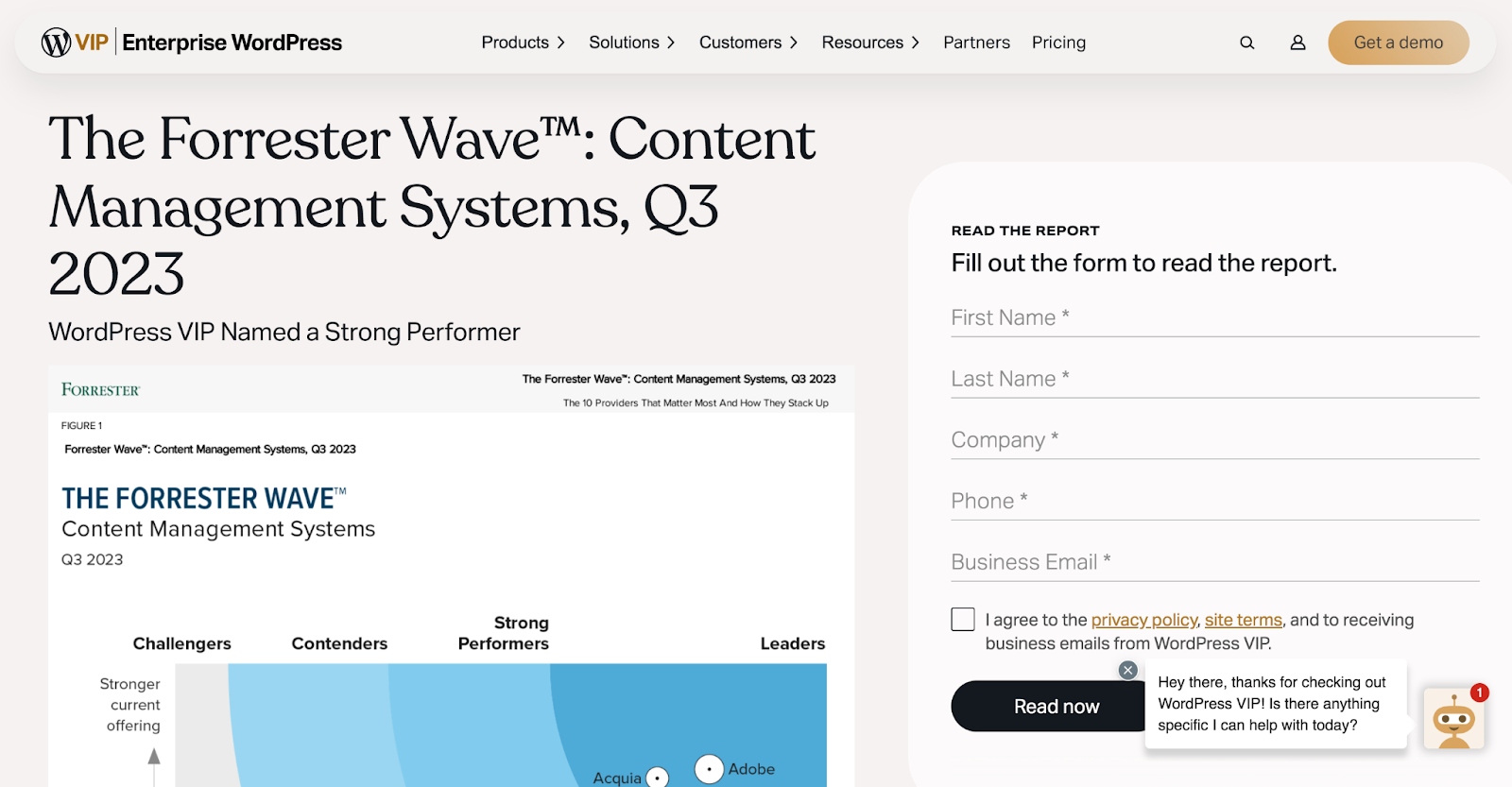
Lead magnets and gated content act as friendly invitations for your audience to exchange their contact information for something of value.
Offering relevant and informative resources captures quality leads and shows your willingness to provide solutions. You can then use the data to send targeted offers and build a relationship with your audience.
Make sure your lead magnet is high-quality, is relevant to your audience, and aligns with your overall content strategy.
Design the lead magnet and pitch your gated content in a way that provides value to the reader, not as a pushy sales tactic.
5. Reduce friction on your lead capture forms
Simplify the information you request from potential leads. It reduces the time and effort required for users to submit their information. The result is a better experience that results in higher conversion rates.
Here’s what a lead gen form looks like from Litmus:

Include this information in your lead capture form:
- Name. Ask for the visitor’s first name to personalize your communication.
- Email address. This is the most crucial information for contact and follow-up.
You could end your form right here and likely get the maximum conversion rate possible. However, the effectiveness of your campaigns that follow this lead capture may hinge upon knowing a bit more about the visitor to segment communications.
If this is the case, you may consider asking a few more questions, like:
- Company name (if applicable). The user’s company helps sales reps understand how to approach a lead and can provide you with better data about who’s responding to your offers.
- Job title (if applicable). The user’s role within their company is valuable for segmenting and tailoring your messaging.
- Location (optional). The location is useful for regional targeting or understanding your audience better.
- Industry or interest (if applicable). If your lead generation efforts are specific to certain industries or interests (or even product lines), include a dropdown menu or checkboxes for users to select from to tailor your communication.
- How they heard about you (optional). Understand how users discovered your brand to get insights into your marketing channels’ performance.
6. Replace CAPTCHA with an AI anti-spam solution
CAPTCHAs are those annoying puzzles or tests you often come across online that require you to prove you’re not a robot by solving them.
These do serve an important purpose, however. Anti-spam solutions stop unwanted or malicious content or actions, like spam comments and emails, from infiltrating websites.
Unfortunately, CAPTCHAs lead to a poor user experience and potential drop-offs from your most important visitors. A study shows that 19% of adults in the United States abandoned online transactions in 2021 when CAPTCHAs appeared.
Akismet is a powerful anti-spam service that detects and blocks spam comments, form submissions, and other unwanted interactions without requiring users to complete a puzzle, check a box, or jump through a hoop. Its key features include real-time spam detection, comment moderation, protection against harmful links, and the ability to learn and adapt to new spam patterns.

Visitors find a trustworthy and safe environment on your website thanks to these features. It creates a positive user experience, increases engagement, and improves the chances of converting visitors into leads.
7. Let prospects test your product with free trials or demos
Free trials or demos give prospects a taste of your tool by allowing them to experience its features and benefits firsthand before making a commitment. Types of free trials include:
- Limited-time trial. Users access the full product for a limited period, after which they subscribe or purchase.
- Feature-limited trial. Users can access the product’s basic features for free but upgrade to access advanced functionalities.
- Demo or guided tour. Prospects get a walkthrough of the product’s capabilities, often with a sales representative explaining its value.
Jetpack’s AI Assistant, an AI writing tool built directly into the WordPress editor, offers a variation of the limited-time trial using credits.
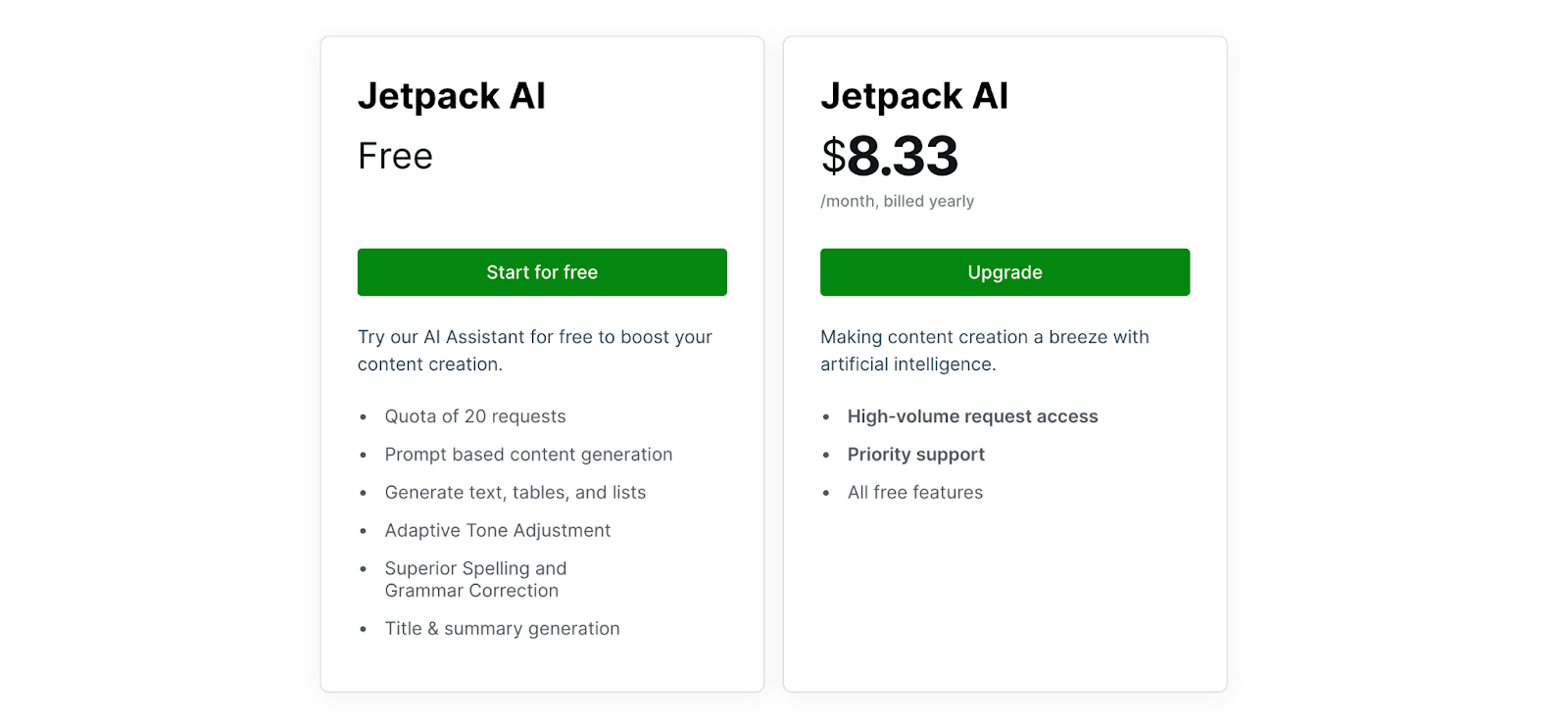
This is a strong offer because it explains the benefit right in the first sentence, “Try our AI Assistant for free to boost your content creation.”
They’re also transparent about long-term pricing with the paid information directly next to the free trial breakdown.
The goal is to make prospects feel comfortable, informed, and excited about your product during this phase. Think about ways you can adjust your trials or language to feel safer for prospects.
8. Showcase your value proposition with compelling case studies
A value proposition is a clear statement that explains how your product or service solves a specific problem or fulfills a need for your target audience.
SaaS marketers often use case studies to boost sales. Why? Because they provide real-world examples of how your solution addresses similar challenges for other customers. They work as social proof.
Here’s a case study from Mailchimp:

The video immediately makes the case study personal.
The case study also highlights stats and customer quotes, which further increase its perceived authority.

It’s also skimmable. Mailchimp breaks down the case study with headers like “The challenge” and “The tools”. The word length also falls just under 1,000 words.
Balancing emotions and hard data in case studies connects with the audience while providing compelling evidence to back up your value proposition.
9. Turn satisfied customers into brand advocates
Convert happy customers into brand advocates by using their positive experiences to spread the word about your brand through recommendations, reviews, and social sharing.
Your existing customers are a powerful source of credibility and influence. This approach works for lead generation because it taps into the trustworthiness of online reviews — 46% of consumers consider them as reliable as personal recommendations from friends or family.
Want to encourage reviews?
Try sending a reminder email to encourage people to leave reviews. Make the process as simple as possible. For example, you might include a button that navigates directly to the review form.
You could also incentivize customers by allowing them to enter a drawing to win a $100 voucher.
Once customers leave reviews, repurpose them as posts on social media platforms.
10. Create a referral program
Referral programs are systems where brands reward existing customers for recommending a product or service to others.
People trust recommendations from friends and family members, so word-of-mouth marketing can lead to higher conversion rates and improved brand loyalty.
PayPal, for example, has a popular referral program.
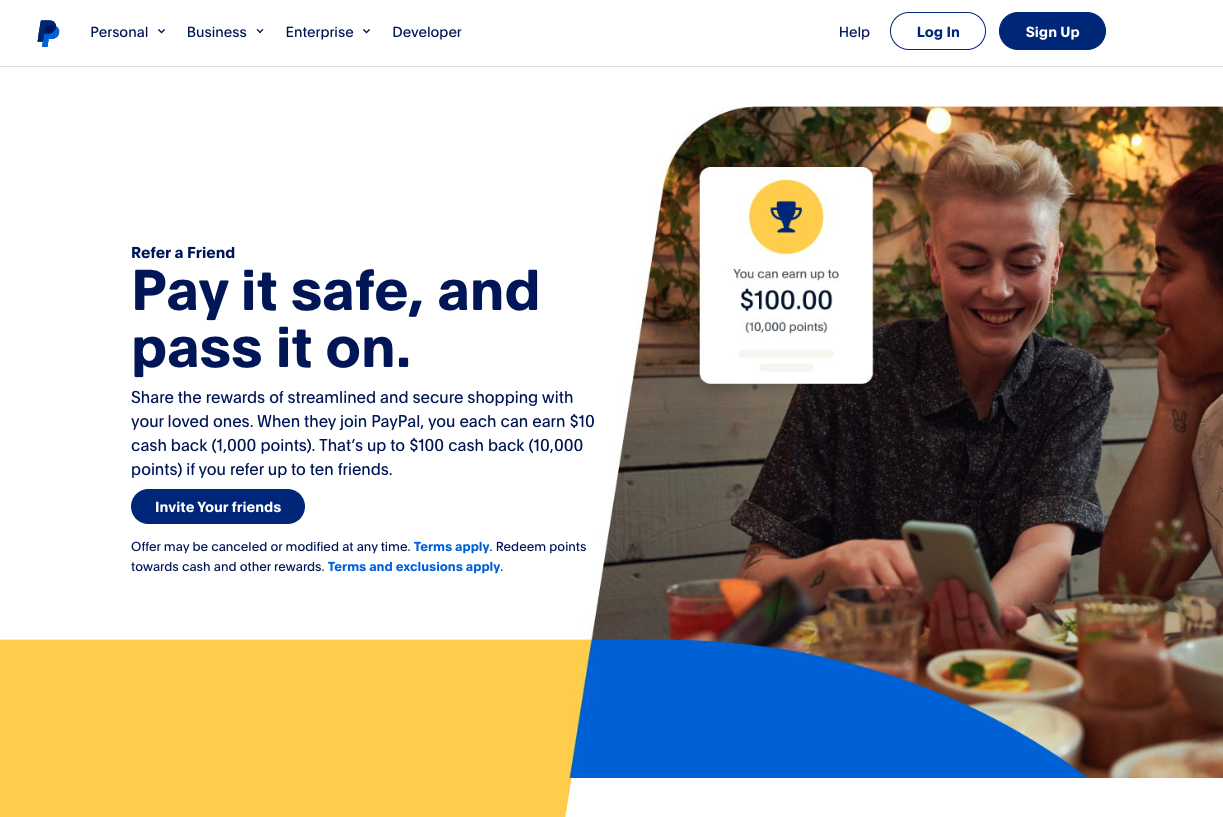
If you refer it to someone, you and they earn $10. It’s a win-win situation — you get up to $100, and PayPal gets more customers.
But a referral program only works well if you offer the right incentives.
Research shows that dollar credit is the most common referral program reward type, used in over 50% of programs for promoters and referred friends. Other incentives include percent discounts, gift cards, subscription time, cash, and points.
11. Invest in user-generated content to build credibility
User-generated content (UGC) is any content created by unpaid contributors — typically customers or users — rather than the brand itself.
UGC works well — research shows that prospective customers consider it the most trustworthy content.
Why? UGC highlights genuine insights and experiences to create a sense of credibility and reliability.
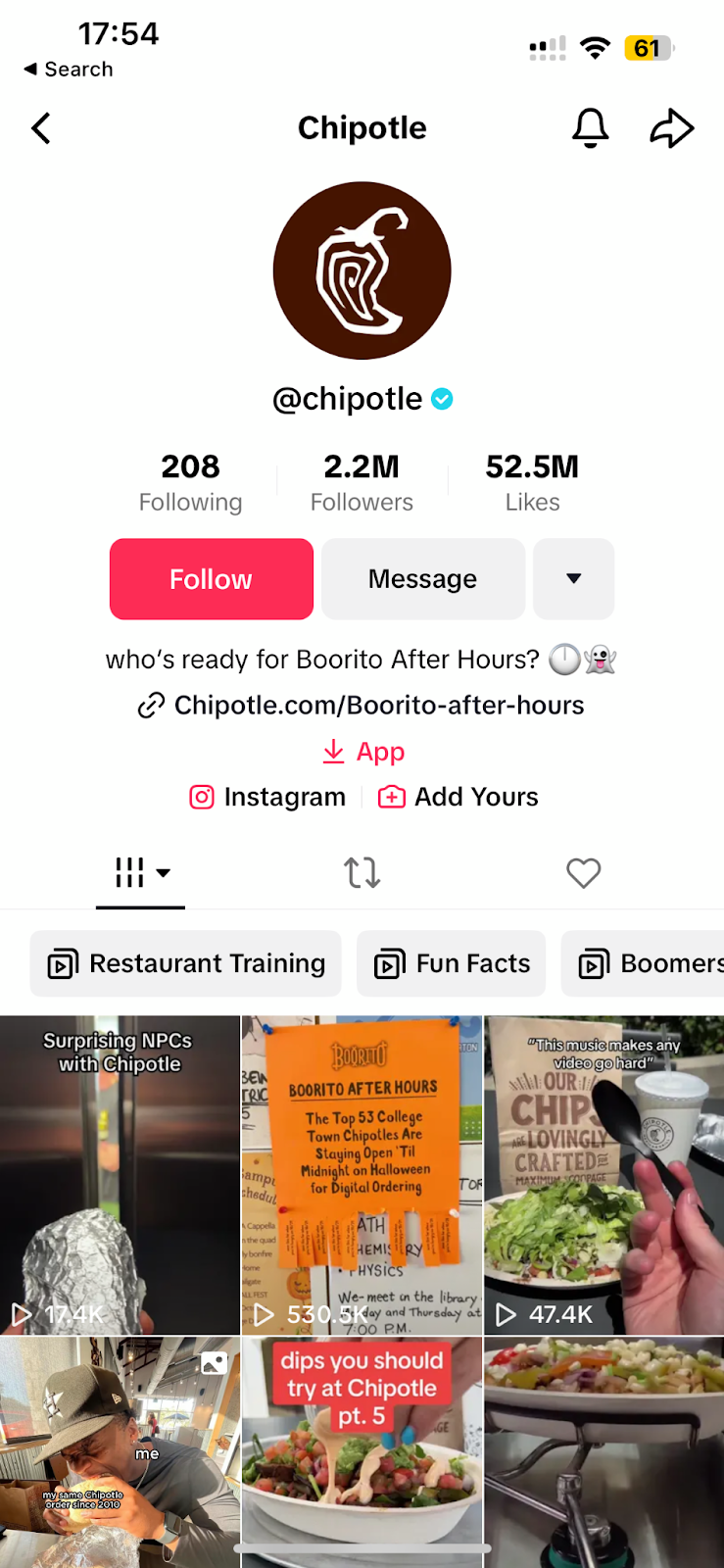
Chipotle’s entire social feed, for example, is full of UGC.
Three ways to generate UGC:
- Run a giveaway or contest. A contest encourages customers to share their experiences with your product or service in exchange for a chance to win a prize. It builds engagement and highlights real user satisfaction and enthusiasm.
- Use a branded hashtag. Branded hashtags invite customers to share their content. These hashtags make UGC easily discoverable, increasing its reach and impact.
- Collaborate with creators and influencers. Content creators and influencers help your UGC reach a broader audience. These individuals often have dedicated and engaged followers who trust their recommendations and experiences.
12. Use social listening to engage with potential leads
Social listening involves monitoring social media channels and online platforms to track and analyze conversations, mentions, and trends related to your brand or industry in real-time.
People now spend an average of two and a half hours on social media every day.

Social listening allows you to tune in to conversations, identify leads, and engage with potential customers you might have otherwise missed.
Set up alerts to receive notifications about specific keywords or mentions. Social listening also gives you more visibility into brand sentiment.
The result is a more proactive approach in your lead generation process — you can respond quicker, initiate conversations, and nurture potential leads through proactive engagement.
13. Expand your reach with cross-promotion partnerships
Cross-promotion partnerships, also known as brand collaborations, are two brands joining forces to promote each other. These partnerships are powerful because they introduce your brand to a new audience that’s likely to already be interested in what you offer.
Let’s say you sell fitness gear, and you team up with a healthy snack brand.
Both kinds of products are used by people interested in improving their health.
Your fitness-loving customers might discover those tasty snacks, and their snack fans might want your awesome gear. These collaborations boost both brands’ visibility and trustworthiness.
14. Use influencer marketing to reach new audiences
Collaborate with individuals who have a significant and engaged following in your niche or industry to tap into their established audience and credibility.
90% of respondents in a survey consider influencer marketing to be effective.
Skincare brand, La Roche Posay, for example, collaborates with Dr. Mamina Turegano, MD, a TikTok influencer and certified dermatologist.

Dr. Marina’s expertise adds a lot of authority to the content, making it a powerful tool in reaching and engaging a specific audience.
Her content is not just promotional — she delivers real value to her followers and backs up her advice with knowledge and experience.
Collaborate with influencers who fit your brand and resonate with your audience for better results.
15. Host a virtual summit to build thought leadership
Virtual summits are online events where experts share insights on a specific topic over multiple sessions or days.
These events establish credibility, build trust, and increase industry authority, positioning you as a go-to source for information and solutions.
Adobe Summit, for example, is a hybrid virtual summit for customers who use Adobe’s digital experience tools.

When hosting a virtual summit, follow Adobe’s lead by inviting authoritative speakers who are experts in your field.

Promote the event well in advance. Adobe, for example, promotes the summit at least six months ahead of time. This builds anticipation and attracts a larger audience.
Also, they provide sneak peeks of the sessions, allowing their audience to gauge whether the summit is worth attending.

To make sure virtual summits help you get new leads, use smart tactics like sign-up forms, materials people can download, and chances for attendees to connect with each other.
These tricks help you collect info and generate leads from attendees and keep these prospects engaged even after the summit.
16. Create a podcast series to showcase your expertise
Podcasts are the new frontier for brand visibility and engagement. Currently, 38% of Americans over age 12 —109 million people — listen to podcasts monthly. They provide a unique platform to share insights, connect with audiences, and establish authority in a format that’s both convenient and increasingly popular.
Bloomberg, for example, has a podcast that focuses on financial and economic insights. It positions the brand as a trusted source for expert analysis and helps it stay connected with its audience.

Here are some tips for creating an engaging podcast series:
- Focus on a specific topic or niche that aligns with your brand’s expertise and target audience’s interests.
- Outline episodes, create a content calendar, and build a consistent posting schedule.
- Share your podcast episodes on social media, your website, and through email marketing to reach a wider audience.
- Invite industry experts or guests relevant to your niche to provide diverse perspectives.
- Optimize your podcast titles, descriptions, and keywords to improve discoverability on podcast platforms.
- Maintain a regular publishing schedule, so your audience knows when to expect content and what each episode will include.
A podcast is a great way to establish your brand’s authority, connect with your audience, and tap into the growing trend.
17. Use webinars to educate and engage potential leads
Webinars are online seminars or workshops that allow you to present information, interact with your audience in real time, and provide valuable education on a specific topic or subject.
A study by the Content Marketing Institute showed that 47% of B2B marketers said webinars produced the best results in 2021. It’s easy to see why: they offer an interactive learning experience and encourage engagement which builds your authority and relationship with potential leads.
AI-powered content tool, Clearscope, for example, hosts regular webinars with industry experts.

Here are some tips on getting webinars right:
- Choose relevant topics: Focus on topics that address your audience’s challenges and interests to ensure engagement and relevance.
- Create an interactive Q&A session. Include interactive Q&A sessions to encourage audience participation and address their specific queries.
- Invite experts. Collaborate with industry experts or influencers to lend credibility and attract a wider audience.
- Promote it. Promote your webinar on social and through email.
- Follow up. Follow up with attendees and provide additional resources or offers to guide leads further down the sales funnel.
18. Engage and qualify leads with live chat operators and bots
Live chat operators and bots qualify leads by having conversations with website visitors.
They ask questions to figure out if a visitor is a good fit for your product or service. If they are, the bots send those leads to the right place for follow-up.
Lead qualification ensures you focus your sales and marketing efforts on individuals who are genuinely interested and likely to convert into paying customers. A strong focus increases efficiency and increases conversion rates.
Tailor bots with specific filters and ask relevant questions. Qualifying questions include:
- What brings you to our website today?
- Are you looking for a specific product or service?
- What is your marketing budget or price range?
- When do you plan to make a decision or purchase?
- Have you used similar products/services before?
- Do you have any specific requirements or preferences?
19. Use retargeting to bring back lost leads
Retargeting involves displaying tailored advertisements to individuals who’ve previously visited your website or engaged with your brand but didn’t take the desired action.
It reminds potential customers of their initial interest and gives them a second chance to convert, ultimately improving conversion rates and ROI.
Suppose you visit Old Navy’s website, browse through some clothing items, but leave without making a purchase. Later, you start seeing Old Navy ads showing the exact items you looked at.

That’s retargeting in action — it gives you a nudge to come back and complete your purchase. It’s a smart lead gen strategy to re-engage lost prospects and turn potential customers into actual ones.
Retargeting only works when you don’t overdo it. Strike a balance and provide relevant, personalized content that genuinely reconnects with the audience’s interests and needs.
20. Target key decision makers with account-based advertising
An account-based marketing strategy creates customized lead generation campaigns just for important leads to win their business.
A targeted focus leads to optimal use of resources, a direct link to key decision makers, and increased chances of landing big deals.
Gartner’s research shows that the typical buying group for a complex B2B solution involves six to ten decision makers. Account-based advertising targets these decision makers with specific ads and messages to address their unique needs and concerns.
Here’s an example of an Indeed ad that targets decision makers at Pepsi:

So, how do you create ads that speak to these individuals?
Start with their challenges. Understand what keeps them up at night and tailor your messaging to provide solutions to these issues. Focus on the benefits of your product or service that directly address their concerns.
What about lead conversion? What are proven best practices?
You’ve attracted leads to your business — what now? Focus on converting these leads into loyal customers. Here are some best practices to maximize your lead conversion rate:
1. Follow up with leads to maintain their interest
Following up with leads reminds them about your business and shows you care about their needs. Persistence matters — studies suggest it can take seven to ten interactions for a lead to become a customer.
When sending follow-up emails, keep them brief, upbeat, and focused on offering something valuable to the lead. Short and positive messages ensure your communication stays engaging and increase the chances of turning leads into loyal customers.
2. Develop a lead scoring system to prioritize leads
A lead scoring system is a method of evaluating and ranking leads based on their level of interest and likelihood to convert into customers. You identify the best prospects by assigning numerical values to different attributes and behaviors.
You focus your efforts and resources on leads with the highest conversion potential with this system.
Scoring leads allows you to optimize your time and resources and maximize your return on investment. Consider these lead scoring tips:
- Set thresholds. Define specific criteria a lead must meet to be considered “sales ready,” like a minimum score indicating high interest or engagement.
- Establish rules. Create rules for how leads are scored based on actions, like opening emails, visiting pricing pages, or downloading resources.
- Assign points. Assign numerical values to different lead behaviors, with higher scores for actions that show stronger interest or intent to purchase.
- Review and adjust. Monitor and refine your lead scoring system as you gather more data and insights to ensure accuracy.
- Collaborate with sales. Establish what constitutes a qualified lead and adjust scoring criteria accordingly to improve lead handoffs and conversions.
3. Use a CRM to manage and track your leads
A customer relationship management (CRM) tool, like Jetpack CRM, is your go-to for staying organized with leads. It keeps all lead info in one place, simplifies communication, and automates tasks.

With Jetpack CRM, sort and track leads, follow their interactions, and watch their journey closely. This makes it easier to give them personalized attention, prioritize who to reach out to, and nurture leads. Plus, it provides smart data to make decisions that boost your chances of converting prospects into loyal customers.
4. Implement email marketing to nurture leads
Stay in touch with potential customers through email marketing and provide them with valuable content, updates, and offers that keep your brand top of mind.
Delivering tailored messages at the right time guides leads through the buying journey and builds trust.
Divide your leads into groups based on interests, behaviors, or demographics to send relevant content to each segment. Use personalization techniques to address leads by name and tailor content to their needs and preferences.
Develop informative and engaging content that addresses your leads’ pain points and interests. You can offer blog posts, eBooks, webinars, or exclusive offers. Set up automated email sequences that deliver a series of messages over time. Gradually introduce leads to your brand, products, and services.
Focus on solving problems and providing value in your emails. Show leads how your offerings benefit them with success stories, testimonials, and case studies.
5. Use customer feedback to improve your sales process
Gather feedback from customers through surveys, reviews, and direct communication. Encourage honest opinions about their experience with your sales team and product. Here’s how to make the most of the feedback you get:
- Analyze responses. Review the feedback to identify recurring themes, issues, or areas for improvement. Look for patterns in what customers appreciate and where they face challenges.
- Prioritize feedback. Categorize feedback into critical issues that need immediate attention and areas for long-term improvement. This ensures you tackle the most pressing concerns first.
- Adjust your sales approach. Based on feedback, refine your approach. Train your sales team to address common concerns and objections.
6. Follow up with customers to encourage repeat business and referrals
Stay in touch with your customers to build an ongoing relationship. A thank-you message after their purchase and asking how their experience was is always a great place to start.
Also, keep them in the loop by letting them know about any new deals or products. If they have questions or issues, provide excellent support. Encourage them to refer friends by offering rewards and making it simple. Staying connected and showing appreciation keeps your customers loyal and earns new ones through their recommendations.
Frequently asked questions
What are some common lead generation mistakes to avoid?
Common lead generation mistakes include not defining your target audience, neglecting data quality, and relying on a single lead generation channel. Failing to nurture leads, ignoring customer feedback, and neglecting mobile optimization can also hinder success.
Make sure you measure and analyze your lead generation efforts so you can optimize them. Don’t forget personalization and adapt to evolving trends. Lead generation is more effective when you avoid these mistakes.
How can I improve my lead capture forms to maximize conversions?
Streamline the form by keeping it concise and requesting only essential information. Use a clear and compelling call-to-action (CTA) that conveys value and implement autofill and smart form features to reduce user effort. It’s also a good idea to A/B test different form layouts and CTA text to identify what resonates best with your audience.
Lastly, reassure users about data security and provide social proof, like trust badges or testimonial snippets, to boost confidence. Regularly analyze form performance and iterate based on insights to optimize for higher conversions.
Should I use CAPTCHA on lead capture forms?
No, using traditional CAPTCHA can frustrate users and reduce conversion rates. Instead, use AI-driven anti-spam solutions like Akismet. This powerful tool filters out spam submissions while providing a seamless experience for genuine users. It also helps you maintain the security of your forms without subjecting users to the inconvenience and frustration of CAPTCHA.
What is Akismet, and how can it help with form conversion rates?
Akismet is an AI-powered anti-spam solution, and a great alternative to CAPTCHA. It improves form conversion rates by filtering out spam submissions, ensuring you capture only legitimate leads. Eliminating CAPTCHA challenges streamlines the lead capture process and creates a user-friendly and frictionless experience. With fewer barriers, visitors are more likely to fill out forms, resulting in higher conversion rates.
What types of companies generally use Akismet?
Akismet is a trusted choice for a wide range of companies, from small businesses and bloggers to ecommerce sites and large enterprises. Over 100 million sites use it to combat spam, making it a go-to solution. Microsoft, ConvertKit, Bluehost, and many others rely on Akismet, attesting to its credibility and reliability in fighting spam.
Akismet: AI-powered anti-spam for lead generation forms
Lead generation forms are the lifeblood of any business that wants to convert website visitors into potential customers. But spam submissions create a challenging user experience and lead to missed opportunities.
That’s where Akismet steps in as a reliable, AI-powered anti-spam solution. Integrating Akismet ensures a smoother, spam-free experience that ultimately improves conversion rates. Try it out today and focus on what matters most — nurturing high-quality leads.
 Akismet